AC Blowing Warm Air? The 3 Most Common Culprits
Warm air from your AC usually comes down to one of three completely separate problems, not one thing that needs a recharge. Here's how to tell which one you actually have.
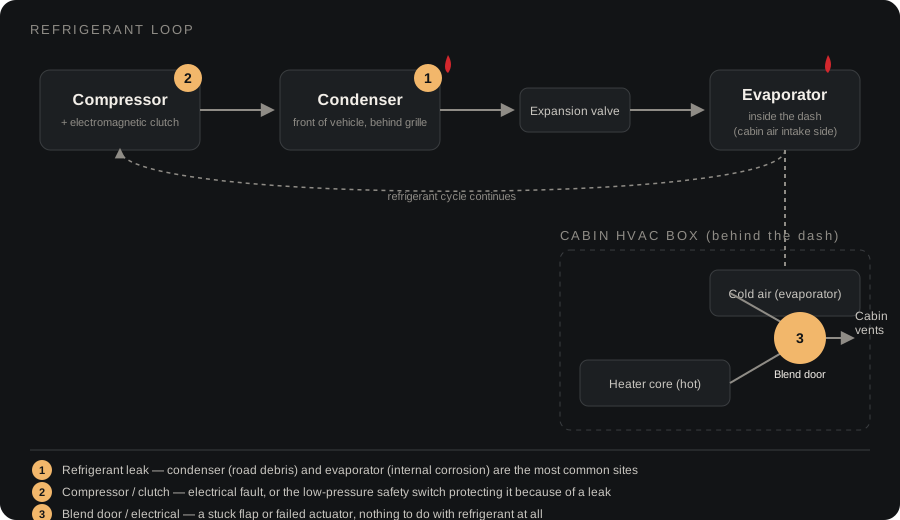
Three Separate Systems, Not Three Versions of the Same Problem
"My AC isn't blowing cold" almost always gets treated as one problem with one fix — recharge it and see what happens. In reality, there are three genuinely separate systems that can cause warm air, and they don't share a fix. Guessing wrong means paying for a recharge that does nothing, or a part that was never the problem. Here's what actually causes it, in order of how often we actually see each one.
Culprit #1: A Refrigerant Leak
Your AC's refrigerant loop is a sealed system. Refrigerant isn't a fluid that gets "used up" the way fuel or oil is — it just cycles between gas and liquid as it moves through the loop, over and over, for the life of the vehicle. That means if the system is low, there is refrigerant missing somewhere, and the only way refrigerant leaves a sealed system is through a leak. There's no such thing as a car that "just needs a recharge every couple years" as routine maintenance — if it's low, something let it out.
The two most common places we find leaks: the condenser, which sits right behind the front grille and takes the brunt of road debris, gravel, and corrosion from salt; and the evaporator, tucked inside the dash, where leaves and debris pulled in through the cabin air intake can decompose and slowly corrode pinholes through the thin tubing from the inside out. Both are real leak sites, not just theoretical ones.
This is also why simply topping off refrigerant without finding and fixing the actual leak doesn't solve anything — it just delays the same warm-air complaint by a few weeks or months, and you pay for the recharge twice.
Culprit #2: The Compressor or Its Clutch
The compressor is what actually pressurizes the refrigerant, and it connects to the engine's belt through an electromagnetic clutch — a coil that engages the compressor only when the AC is switched on. When this fails, you typically get no cold air at all: no click when you hit the AC button, sometimes a squeal as the belt tries to turn a pulley that won't engage, or rapid clicking as the clutch cycles on and off every few seconds. Common causes are mundane — a blown fuse, a failed relay, a burnt-out clutch coil, or a corroded ground wire.
Here's the part that surprises people: a "dead compressor" complaint is often actually Culprit #1 in disguise. Every AC system has a low-pressure safety switch that deliberately keeps the compressor from engaging at all once pressure drops too far — usually somewhere around 25 psi. That's not a malfunction; it's protecting the compressor, because the refrigerant is also what circulates the compressor's lubricating oil. Run it with too little refrigerant and you risk destroying the compressor from lack of lubrication. So "the compressor won't turn on" and "there's a refrigerant leak" are frequently the exact same underlying problem, which is exactly why guessing at parts instead of pressure-testing the system first can mean paying for a compressor that was never actually broken.
Culprit #3: The Blend Door
This one has nothing to do with refrigerant at all. Inside the HVAC box behind your dash, a small flap called the blend door physically mixes cold air (from the evaporator) with hot air (from the heater core, fed by engine coolant) to land on whatever temperature you've dialed in. A small electric motor called an actuator moves that flap. If the actuator fails, or the door itself gets stuck, you can end up with warm air blowing even though the refrigerant side of the system is perfectly healthy — the flap is just physically stuck routing air past the heater core.
Typical signs: cabin temperature that drifts or fluctuates on its own regardless of what you set, clicking, grinding, or buzzing noises from behind the dash near the steering column when you adjust the temperature dial, or a system that only responds properly at certain settings (full hot works, but nothing in between does). If your AC "used to work fine and now blows warm no matter what," but there was no gradual fade first, a stuck blend door is worth ruling out before assuming it's a refrigerant problem.
What to Actually Do
All three of these show up the same way from the driver's seat — warm air instead of cold — which is exactly why they get mixed up. Telling them apart takes actually checking system pressures, testing the clutch circuit electrically, and confirming the blend door moves through its full range, not guessing based on symptoms alone. That's the difference between paying for the one part that's actually broken and paying for a recharge, a compressor, and a blend door motor one at a time until something finally works.
Current pricing for AC service and diagnostics is on our pricing page, and you can see the full breakdown of what's included on our A/C repair and diagnostics page.