How Noticing Small Problems Early Can Save You Thousands on Car Repairs
AAA data shows small, ignored problems routinely turn into repairs costing hundreds or thousands more. Here's what to actually watch, listen, and check for.
The Habit That Actually Pays For Itself
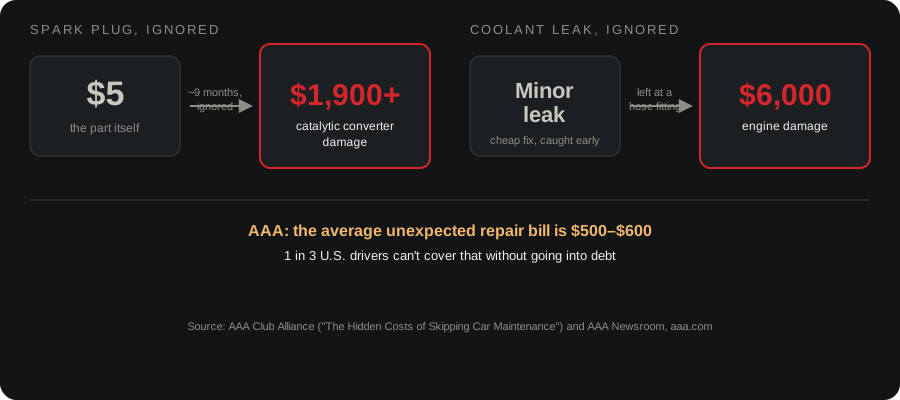
Most expensive car repairs don't start as expensive car repairs. They start small — a light on the dash, a spot under the car, a sound that wasn't there last week — and get expensive because nobody looked closely enough to catch them while they were still cheap. AAA has documented this pattern with real numbers: a five-dollar spark plug ignored for about nine months can turn into over $1,900 in catalytic converter damage. A minor coolant leak at a hose fitting, left alone, caused $6,000 in engine damage in another documented case. Neither of those started as a big problem. Here's what to actually notice, and why it's worth the thirty seconds.
What Your Car Is Already Telling You
Dashboard warning lights follow a color system for a reason: red means stop and address it now (oil pressure, brake system, temperature/overheating), while amber or yellow means something needs attention soon, not necessarily today. The problem isn't that this system is confusing — it's that people ignore it anyway. A 2024 survey from Direct Line Group found 43% of drivers ignore dashboard warning signs, and 15% leave a light on for more than a week before doing anything about it. Of the drivers who ignored a warning light, 18% went on to break down, 10% had an accident, and 11% caused actual damage to their vehicle as a direct result. The light isn't the annoying part — driving past it for weeks is what turns a warning into a breakdown.
The Puddle Test: What's Under Your Car Is a Diagnosis
A quick glance at your parking spot tells you more than most people realize. Fluid color is a genuinely reliable clue:
- Brown or black, oily: engine oil.
- Green, yellow, orange, or pink, with a sweet smell: coolant — don't ignore this one, since it's directly tied to overheating and head gasket damage.
- Red, slick, odorless: transmission fluid.
- Reddish with a sweet, slightly burnt smell: power steering fluid.
- Light or dark brown, slippery: brake fluid — if this is what's leaking, don't drive the car until it's checked. It's the one fluid on this list tied directly to your ability to stop.
- Clear liquid, no smell: almost always just AC condensation. Completely normal, nothing to worry about.
As a rule of thumb, a puddle roughly three inches or wider is considered a serious leak worth same-week attention, not a "keep an eye on it" situation.
60 Seconds With a Penny
Tire tread is just as easy to check and just as often skipped. Take a penny, turn it upside down so Lincoln's head points into the tread, and push it into a groove. If the tread covers the top of his head, you're fine. If you can see all of it, you're at or below 2/32", the legal minimum tread depth in most states — and by that point you're already past the point most tire safety organizations actually recommend replacing, which is closer to 4/32" (the same test with a quarter instead of a penny), especially for wet-weather grip. Check three spots across each tire — inside edge, center, outside edge — since uneven wear between those spots usually points to an alignment or tire pressure issue worth mentioning at your next visit, not just a tire problem.
Why This Actually Saves Real Money
This isn't a hypothetical. AAA's own data puts the average unexpected repair bill at $500 to $600 — and found that roughly one in three U.S. drivers would have to go into debt to cover it. Separately, AAA-documented cases show a $5 spark plug becoming $1,900+ in catalytic converter damage after about nine months of neglect, and a minor coolant hose leak turning into $6,000 in engine damage. The gap between "caught it early" and "ignored it" isn't small — it's often the difference between a routine visit and a repair bill that requires financing.
What to Actually Do
None of this requires expertise — it requires thirty seconds of actually looking. Glance under the car before you back out of your parking spot. Don't just silence a dashboard light, read what it's telling you. Run the penny test on your tires a couple times a year. And when something looks, sounds, or smells different than usual, get it looked at while it's still a small problem — that's exactly what a general diagnostic visit is for. See our diagnostic services for what that actually involves, or current pricing is on our pricing page.