How Often Do You Really Need to Change Your Oil in 2026?
The 3,000-mile rule is decades out of date. Here's what modern intervals actually look like, and real numbers on why skipping oil changes gets expensive fast.

The "Every 3,000 Miles" Rule Is Decades Out of Date
If you learned to drive before the 2000s, you probably grew up on one rule: change your oil every 3,000 miles, no exceptions. That number wasn't arbitrary — it made sense for the conventional oils and looser engine tolerances of that era. It just hasn't been true for most vehicles in a very long time.
Modern full-synthetic oils are formulated to resist breakdown, hold their viscosity, and keep contaminants suspended for far longer than the conventional oils that rule was built around. Combine that with tighter manufacturing tolerances and better filtration, and most manufacturers now spec intervals of 7,500 to 10,000 miles under normal driving — some push that even further. Sticking to 3,000 miles on a modern synthetic-oil vehicle isn't dangerous, but it is paying to throw away oil that still has useful life left in it.
What Actually Determines Your Interval
There's no single number that applies to every car, and guessing wrong in either direction costs you. Three things set your real interval:
- Oil type. Conventional oil breaks down faster and generally still wants changing around 3,000-5,000 miles. Full synthetic can usually go 7,500-10,000+ miles. Synthetic blends land in between.
- Your owner's manual, not internet averages. Manufacturers set intervals based on testing specific to that engine — identical oil can carry a different recommended interval on two different vehicles.
- Severe vs. normal duty. Short trips under 10 minutes, a lot of stop-and-go traffic, towing, extreme heat or cold, and dusty roads all count as "severe service" in almost every manufacturer's schedule — and severe service intervals usually run roughly half the normal-duty number. A lot of daily driving around Avon actually falls into severe service more often than people realize, especially with frequent short local trips.
If your vehicle has an oil life monitoring system — that percentage readout on the dash — trust it over a flat mileage number. It isn't just counting miles; it's estimating actual oil condition from engine temperature, RPM, and trip length.
What Skipping Oil Changes Actually Costs
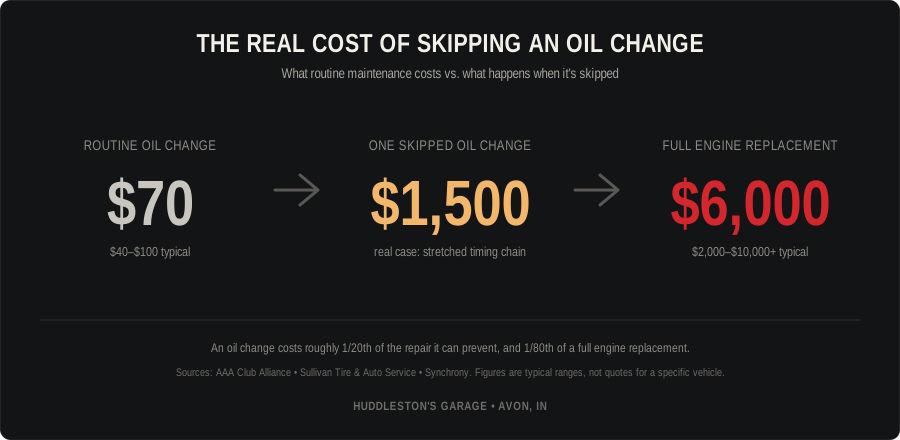
Here's where the real money gets lost. Oil doesn't just lubricate — it also carries heat away from the engine and keeps combustion byproducts suspended instead of settling into sludge. As oil breaks down past its useful life, it does both of those jobs worse, and the damage compounds quietly in the background for months before anything feels different behind the wheel.
Delayed oil changes accelerate wear on bearings, piston rings, and the timing chain or belt — parts that are expensive and labor-intensive to replace, and none of which fail on a convenient schedule once oil quality drops. Skip changes long enough and sludge can restrict oil flow to critical components entirely, which is how a routine, inexpensive maintenance item turns into a four- or five-figure engine repair, or a full engine replacement.
The pattern we see most in the shop isn't dramatic neglect. It's a handful of oil changes pushed back "just a little" over a few years, each one seeming harmless on its own, until the cumulative wear catches up all at once.
What to Actually Do
You don't need to guess at this or split the difference between an old rule of thumb and marketing claims. Bring in your owner's manual, or tell us your vehicle and we'll look up the factory-recommended interval for that specific engine — and tell us honestly how you actually drive it: short trips, long highway commutes, towing. We'll set a real interval instead of a generic one. If your vehicle has an oil life monitor, we'll also check that it's reading accurately, since a sensor issue can make it over- or under-estimate how much life is actually left.
Current pricing for oil changes and full fluid services is on our pricing page — worth a look before assuming synthetic is out of budget, since the longer interval usually offsets most or all of the higher per-change cost anyway.